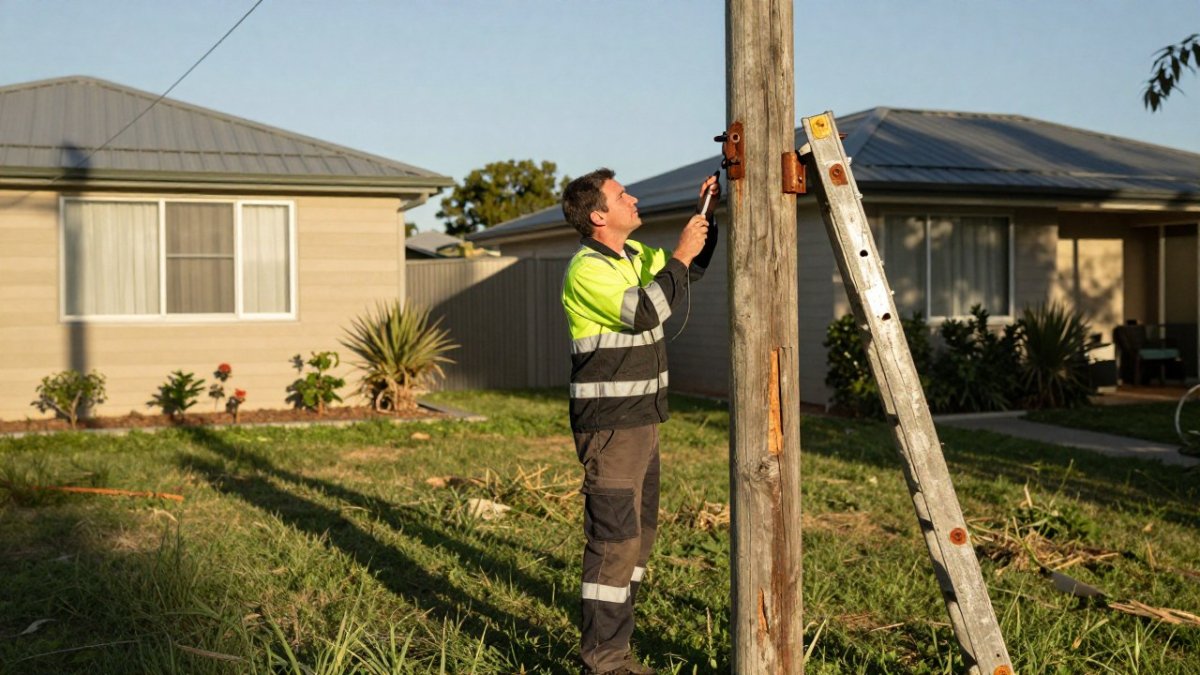
8 Safety Risks of Old Power Poles Near Homes
Last Updated: November 19, 2026
Quick Summary
Old power poles near homes can fail without warning, and the serious danger is what they hold up: a falling pole brings live overhead powerlines down with it, which can energise fences, gutters and standing water. Stay at least 8 metres back from any fallen line and call the distributor's fault line, or 000 if there is fire or injury.
- Timber poles rot from the inside out, so the outer shell can look solid while the core has gone soft.
- A pole needs replacing when it leans, splits, shows base rot, or has damaged fittings, cross arms or frayed wires.
- The property owner is responsible for a private power pole in Queensland, including maintenance, repair and replacement.
- Never prune trees near powerlines yourself; report trees touching lines to the distributor instead.
- Book a private power pole inspection before storm season, not after, with a licensed electrician.
Table of Contents
- What Makes Old Power Poles a Risk to Your Home
- Signs a Power Pole Needs Replacing: A Homeowner's Checklist
- Falling Poles, Downed Lines and the Real Danger to People and Property
- Who Is Responsible for a Private Power Pole in Queensland?
- Trees, Vegetation and Powerlines: Keeping a Safe Distance
- Damaged Power Pole Near House: What to Do Right Now
- Private Power Pole Replacement on the Gold Coast: When to Act
- Book a Private Power Pole Inspection in Tugun
- Frequently Asked Questions
What Makes Old Power Poles a Risk to Your Home
An old timber power pole near your home is a structure under constant load, and once decay sets in, that load has nowhere safe to go.
A private power pole is a pole on your property that carries your electrical supply from the network to your meter. It is not the same as a pole owned by the electricity distributor.
That distinction matters more than most homeowners realise.
How Poles Deteriorate With Age
Timber poles rot from the inside out. The outer shell can look solid while the core has already gone soft. Groundline rot is the classic failure point, because moisture sits at the soil line and never dries out. Steel poles rust from the base up, and cross arms crack where fittings bite into the timber.
Age alone does not condemn a pole. Neglect does.
Rot, Rust and Termite Damage
Three things kill private poles in this climate:
- Decay and rot at the base, where water pools
- Rust on steel fittings, bolts and cross arms
- Termite damage in untreated timber, often invisible from ground level
Termites are the quiet one. A pole can carry live powerlines with a hollow centre for years before anything shows.
Signs a Power Pole Needs Replacing: A Homeowner's Checklist
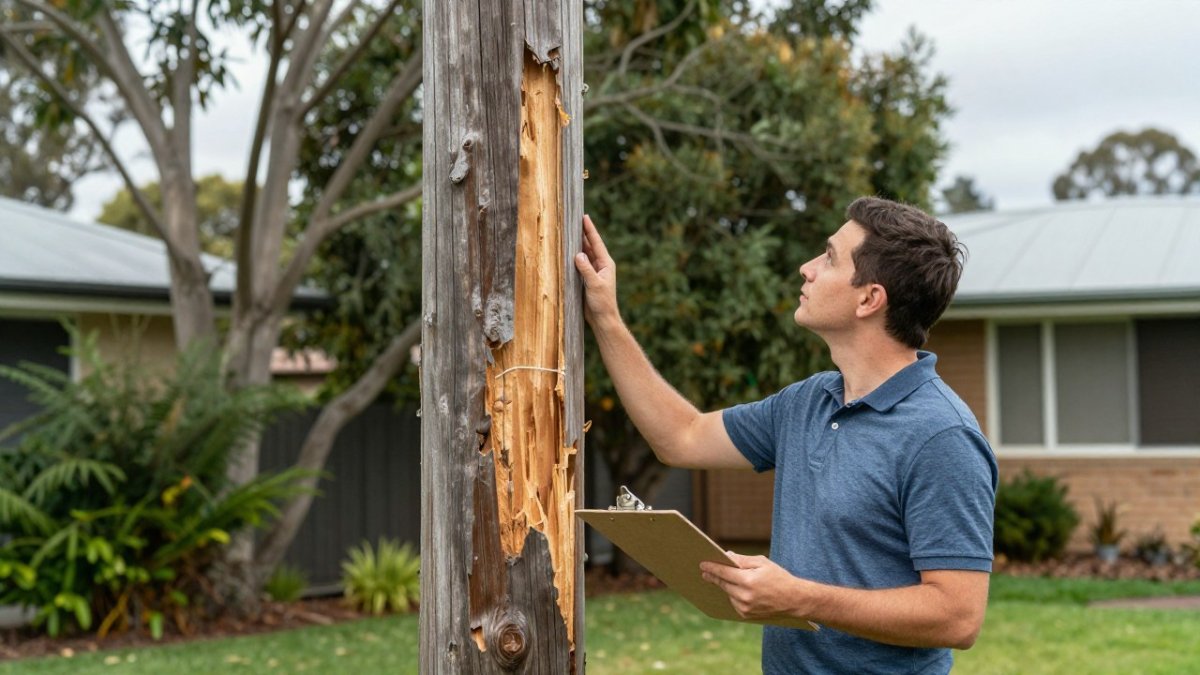
A pole needs replacing when it leans, splits, shows rot at the base, or has damaged fittings, cross arms or frayed wires. Any one of these is enough to book a professional inspection. Do not climb it or touch it yourself.
First, work out who owns the pole
Before you can act on anything you see, you need to know whether the pole is yours or the network's. Ownership decides who inspects, who repairs, and who you ring. A quick test is to follow the service line from the point it leaves the street: if the pole sits inside your property boundary and carries only your supply to your meter, it is almost certainly a private pole.
Ground-level inspection checklist
Run this from ground level, from a safe distance, and never touch, climb or lean on the pole:
- Is the pole leaning more than it used to, or has the lean changed since last season?
- Are there splits, cracks, holes or soft patches in the timber?
- Is the base sunken, ringed with rot, or hollow when you look at it from arm's length?
If you tick even one box, get it checked by a licensed electrician. Visual inspection can flag a problem, but it cannot certify a pole as safe, only a close assessment by a licensed professional can do that.
How often to check, and when to escalate
A quick ground-level look each season and after any severe storm is a sensible habit, with a professional assessment for older poles or any pole that has already been flagged. Escalate immediately, do not wait for a routine booking, if the pole is leaning noticeably, if wires are down or sagging low, if you can see sparks or hear arcing, or if the pole is smoking or on fire.
Reporting a hazard in Tugun
The distributor to ring for a downed line or hazard depends on the network area; check your electricity bill or the distributor's website to confirm.
If you tick a box and want a second opinion, our guide on how to spot unsafe power poles walks through each sign with photos so you can compare against your own pole.
Run this ground-level checklist from a safe distance, and if you tick even one box, get the pole checked by a licensed electrician.
| Warning sign | What to look for |
|---|---|
| Changed lean | Pole leaning more than before, or lean changed since last season |
| Timber damage | Splits, cracks, holes or soft patches in the timber |
| Base rot | Base sunken, ringed with rot, or hollow from arm's length |
| Cross arm damage | Cross arms cracked, sagging or rusted through at bolt holes |
| Wire problems | Wires frayed, sagging low, or touching tree branches |
| Rust | Rust streaking down the pole, fittings or stay wires |
| Ground movement | Ground around the base shifted, eroded or stayed boggy |
| Termites | Termite mud or damage visible on the timber |
Falling Poles, Downed Lines and the Real Danger to People and Property
The serious danger is not the pole itself. It is what the pole is holding up. A falling pole brings live overhead powerlines down with it, and a fallen line can energise fences, gutters, garden tools and standing water. The mechanism matters: current from a downed conductor travels through anything conductive that touches it and through the ground itself, so the danger zone is wider than the wire.
Electric shock and electrocution hazards
Downed powerlines can stay live. Assume every fallen line is live and stay at least 8 metres away. That distance applies to you, your family and your pets.
Watch out: people are injured every year by stepping near a downed line they assumed was dead, the current can travel through the ground and reach you before you see the wire.
Bushfire and ground fire risks
Damaged fittings, frayed wires and dry vegetation near poles all create fire hazard, and strong winds make it worse. A spark near dry grass in a Queensland summer is a ground fire waiting to spread to your home. Vegetation management is not cosmetic, it is fire protection. Keep grass and debris clear of the pole base, and report trees touching lines to the distributor rather than pruning them yourself.
Risks to nearby homes, people and property
A pole failure is not just an electrical event. Falling conductors can start a grass or structure fire, damage roofs, gutters and fences, and cut supply to your home and your neighbours. During severe weather, storms, high winds, lightning, stay clear of windows near overhead lines, keep pets inside, and treat any fallen line as live until the distributor confirms otherwise.
What to do right now if a pole or line is down in Tugun
- Keep everyone, including pets, at least 8 metres back.
- Warn neighbours and stop anyone approaching.
- Ring 000 if there is fire, smoke, sparks or someone injured.
- Ring the Energex fault line to report the hazard, give the street address, nearest cross street, what you can see and whether lines are down.
- Do not attempt repairs, do not cover the damage, and do not touch the pole, wires or anything they contact.
Once the distributor has made the site safe, a licensed electrician can assess any private pole involved and advise on repair or replacement.
Who Is Responsible for a Private Power Pole in Queensland?
The property owner is responsible for a private power pole in Queensland. If the pole sits on your land and carries your supply only, maintenance, repair and replacement are yours.
Not sure which is which? Check your property boundary, your meter location, and any paperwork from the distributor. If you have received a defect notice, our explainer on private power pole defect notices covers what it means and what happens next.
Trees, Vegetation and Powerlines: Keeping a Safe Distance
Trees near powerlines are a leading cause of outages and fires, and branches can carry current to the ground. Keep trees well clear of overhead powerlines and never prune near lines yourself. Falling branches during strong winds are the most common trigger.
Rules to follow:
- Never trim branches within reach of powerlines
- Watch for trees growing into the safe distance over time
- Clear dry grass and debris from around the pole base
- Report trees touching lines to the distributor
Damaged Power Pole Near House: What to Do Right Now
A damaged power pole near your house means one thing: stay away and call for help. Do not touch the pole, the wires or anything they contact.
Do this in order:
- Keep everyone, including pets, at least 8 metres back
- Warn neighbours and stop anyone approaching
- Call the electricity distributor's fault line, or 000 if there is fire or someone is injured
- Report a hazard clearly: address, what you can see, whether lines are down
- Do not attempt repairs or cover the damage
Watch out: people are injured every year by stepping near a downed line they assumed was dead. Wet ground and metal fences carry current further than you think.
Private Power Pole Replacement on the Gold Coast: When to Act
Act when the pole is unsafe, when the distributor has issued a defect notice, or when repair is no longer economic. Our Gold Coast replacement guide covers the process, and our 2026 cost breakdown covers budgeting.
As a local, owner-operated team, the person who quotes the job performs the installation. You deal with the same licensed electrician from first call to switch-on.
Book a Private Power Pole Inspection in Tugun
Book a private power pole inspection in Tugun before the next storm season, not after.
If you are searching for a power pole inspection on the Gold Coast, we provide clear, itemised quotes without jargon, and we are fully licensed and insured.
Don't wait for a lean to become a fall. Book an electrical inspection with Brux Electrical and get a straight answer on your pole's condition, with a fixed quote and no surprises.
A leaning pole or a defect notice is not something to sit on.
Frequently Asked Questions
What are the safety risks of an old power pole near a home?
An ageing pole can rot, split or lean until it fails, dropping live overhead powerlines onto your yard. That creates electric shock and electrocution hazards, fire risk from damaged fittings or dry vegetation, and property damage if the pole or lines fall on a house, fence or car. Termites and rust speed up the decline. Any pole showing cracks, a lean or damaged cross arms should be assessed by a licensed electrician before the next storm season.
Who is responsible for maintaining a private power pole in Queensland?
If the pole sits on your property and supplies your home or a shared connection you own, responsibility for its upkeep and replacement rests with the property owner, not the electricity distributor. Poles owned by the network are the distributor's job. Check your title documents or ask your distributor to confirm ownership. If it is a private power pole, a licensed electrician can inspect it and advise on repair or replacement.
What should I do if a power pole on my property is leaning or damaged?
Stay at least 8 metres clear of any leaning pole or fallen line and keep others, pets and vehicles away. Do not touch the pole, lines or anything they contact. Call your electricity distributor immediately to report the hazard, and call Triple Zero (000) if a line is down or someone is at risk. Once the area is safe, arrange a licensed electrician to inspect a private pole and confirm whether it needs repair or replacement.
When should a private power pole be replaced rather than repaired?
Replacement is usually the safer call when a pole has significant rot at the base, deep splitting, termite damage through the core, or a lean that cannot be corrected. Minor issues like loose fittings or damaged cross arms can often be repaired. An electrician can assess the pole's condition and give you a clear recommendation. On the Gold Coast, salt air, humidity and storms accelerate deterioration, so older poles deserve regular inspection.

