Is a Solar Battery Worth It? Tugun Homes Compared
Last Updated: November 10, 2026
Quick Summary
A solar battery is worth it in Tugun when your home exports a large share of its daytime solar and then draws grid power after dark. The battery stores surplus you would otherwise sell at a low feed-in rate and uses it when your import rate is higher. Payback depends on your usage pattern, so check your own bills before deciding.
- Batteries pay off most when your evening consumption is high and self-consumption is low.
- The financial case depends on the gap between your feed-in tariff and your import rate.
- Confirm the current rebate on the Clean Energy Regulator website and check it on your quote.
- Size the battery to your measured evening usage, not to your roof size.
- A standard grid-tied battery may shut down during a blackout unless designed for backup.
Table of Contents
- When a Solar Battery Pays Off for a Tugun Home
- Solar Battery Cost on the Gold Coast and Available Rebates
- Solar Battery Payback Period in Australia: Worked Scenarios
- Choosing the Best Solar Battery Size for a Home
- What a Battery Can and Cannot Do During a Blackout
- Alternatives to Buying a Battery and Next Steps
- Frequently Asked Questions
When a Solar Battery Pays Off for a Tugun Home
A solar battery is worth it in Tugun when your home exports a large share of its daytime solar and then uses electricity after dark. Batteries store the surplus you would otherwise send to the grid at a low feed-in rate, and release it when your import rate is higher. Whether that gap justifies the upfront cost depends on your household's usage pattern, not on the battery itself.
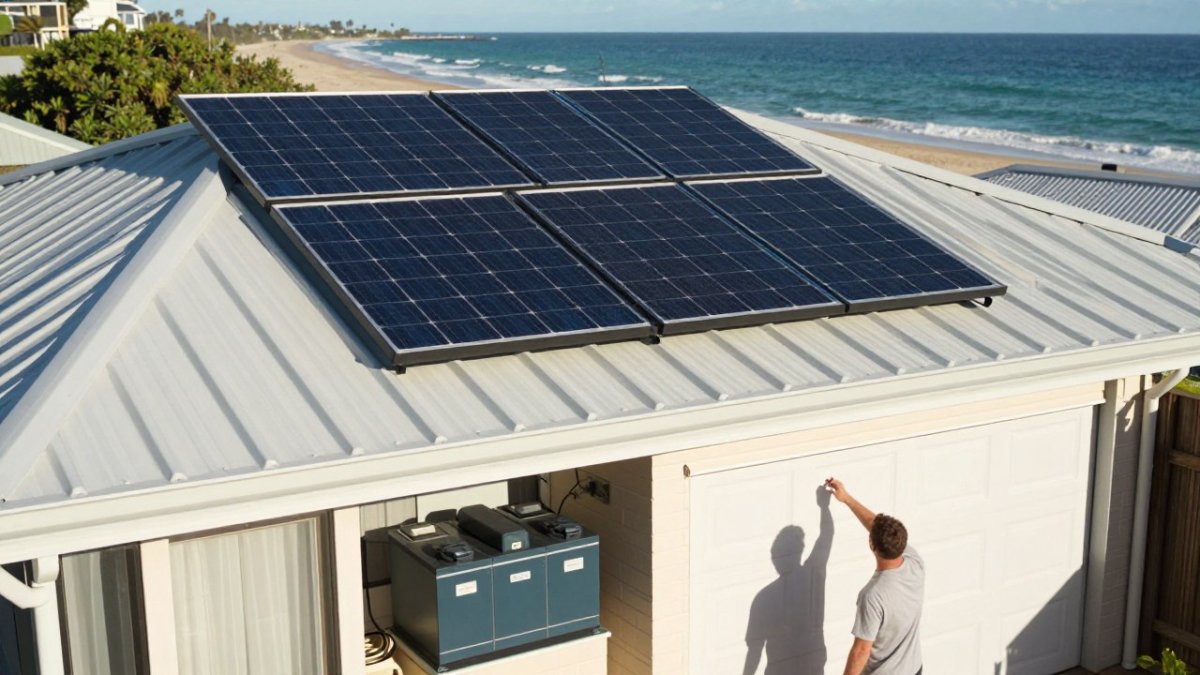
Households at home during the day with a large panel array often export more than they use. Households out at work with modest panels rarely have enough surplus to make a battery pay. The sizing question and the economics question are the same question.
How self-consumption changes the answer
Self-consumption is the share of your solar generation you use directly in your home. The higher that share, the less a battery adds, because you are already using the power as it is produced. A battery matters most when your self-consumption is low and your evening consumption is high.
For example, a family that runs air conditioning, cooking and laundry after 5 pm can send much of its midday solar to the grid, then buy power back at night. A battery captures that evening demand. A couple who are out all day may use most of their solar while it is generated, leaving little for a battery to store.
Installing a battery larger than your evening load means you pay for capacity that never cycles. Size to the usage you can measure.
Feed-in tariffs versus import rates
The financial case rests on the difference between two numbers. The feed-in tariff is what your retailer pays for power you export. The import rate is what you pay when you draw power from the grid. A battery earns its keep by shifting energy from the low-value export to the high-value evening use.
If your feed-in tariff is low and your import rate is high, that gap is where a battery creates value. If the two rates sit close together, the saving per stored kilowatt-hour shrinks and the payback stretches. Check both figures on your current bill before you accept any savings estimate.
Solar Battery Cost on the Gold Coast and Available Rebates
A home battery is a significant purchase, and the price varies more than most homeowners expect. Usable capacity, the brand and its warranty, the inverter configuration, the complexity of the switchboard work and the access to the install site all move the figure. A figure without the scope attached tells you little, so insist that each quote lists the capacity, the inverter and the included labour.
Government support is the other lever. The Cheaper Home Batteries Program is the national incentive for eligible home batteries, administered through the Clean Energy Regulator (Solar batteries).
Because the program's settings are updated periodically, do not rely on a rebate figure from an older article or a verbal quote. Confirm the current rebate calculation on the Clean Energy Regulator website, then ask your installer to show the rebate line on the written quote (Battery rebates are changing 1 May 2026). The net cost, after the rebate, is the number that feeds the payback calculation, so it should be stated clearly.
Two practical checks help. First, confirm that the installer is accredited and that the battery model appears on the eligible list for the program. Second, ask whether the quoted price includes the switchboard upgrade or any required electrical works, since those costs are sometimes excluded from a headline price and can change the net outlay materially.
Solar Battery Payback Period in Australia: Worked Scenarios
The payback period is the number of years it takes for bill savings to recover the net cost of the battery. It is a simple division, but the inputs carry most of the uncertainty, so the useful exercise is to show the working rather than quote a single headline figure.
The basic formula is net cost divided by annual net saving. Net cost is the installed price minus any rebate that applies at the time of installation. Annual net saving is the value of the energy the battery shifts from export to evening use, minus the export income you give up by storing it, minus any ongoing costs.
To make that concrete, consider an illustrative household in Tugun with a 6.6 kW solar array and a 10 kWh usable battery. The household exports roughly 8 kWh a day on a sunny day and draws around 9 kWh from the grid after sunset. Assume the battery can cover about 7 kWh of that evening load each day, with a round-trip efficiency of 90 per cent, meaning it returns about 6.3 kWh of stored energy for every 7 kWh put in.
With an illustrative import rate of 35 cents per kWh and a feed-in tariff of 5 cents per kWh, the saving per stored kilowatt-hour is the avoided import cost minus the forgone export income. Each kilowatt-hour that would have been exported and is instead used at night is worth roughly 30 cents more. Over a year that scenario yields a material annual saving, and dividing a net installed cost after rebate by that figure produces a payback in the range that makes sense for a battery with a warranty of around ten years.
The same calculation changes sharply if the inputs move. Three sensitivities matter most for a Tugun home:
- Tariff narrowing: if the import rate falls or the feed-in tariff rises, the gap that the battery exploits shrinks and payback lengthens.
- Degradation: lithium batteries lose usable capacity over time, so the savings in later years are smaller than in the first year. Check the warranty's end-of-life capacity threshold.
- Behaviour: a household that already runs its dishwasher and laundry during the day raises self-consumption and reduces the energy available for the battery to shift.
Watch out: a payback figure that omits export income forgone or assumes a 100 per cent round-trip efficiency will look more favourable than it is. Ask any installer to show the assumptions alongside the result, and rerun the sum with your own bill data before you decide.
The worked example above uses illustrative numbers to demonstrate method. Your own payback depends on your metered usage, your current retail plan and the rebate you qualify for, so the most reliable figure comes from your own smart meter data rather than a published average.
The worked scenario below shows how the payback inputs combine, and which assumptions move the result most.
| Input | Illustrative value | Why it matters |
|---|---|---|
| Solar array | 6.6 kW | Sets how much surplus the battery can store |
| Usable battery | 10 kWh | Caps how much evening load it can cover |
| Import rate | 35 cents per kWh | Value of energy the battery replaces |
| Feed-in tariff | 5 cents per kWh | Export income given up when storing |
| Round-trip efficiency | 90 per cent | Share of stored energy returned |
| Payback formula | Net cost ÷ annual net saving | Result depends on rebate and inputs |
Choosing the Best Solar Battery Size for a Home
The right battery size matches your evening energy use, not your roof size. Start with your bills and smart meter data to see how much you consume between sunset and the next sunrise. Then choose usable capacity that covers that window without leaving large amounts unused.
Brands and models vary. Which one suits you depends on compatibility with your inverter, warranty terms and the quote you receive. Compare the same specifications across every proposal.
For a step-by-step method to work out the capacity you need, read How to Size a Home Solar Battery: 2026 Guide. To see the current options side by side, see Best Solar Battery Systems 2026. If you are weighing chemistry as well as size, Lithium vs Lead Acid Batteries for Solar: 2026 Guide explains the trade-offs.
What a Battery Can and Cannot Do During a Blackout
A battery can keep essential circuits running during a grid outage, but only if the system is designed with backup capability and the circuits are wired to it. A standard grid-tied battery may shut down when the grid goes down, which many homeowners do not expect.
Backup power is limited by usable capacity and the loads you connect. Air conditioning and electric cooking draw heavily and drain storage quickly. Plan a backup circuit list with your electrician and understand that outage protection is a design feature, not an automatic benefit of owning a battery.
For practical guidance on running power through storms and outages, see Managing Off-Grid Power During Storms.
Alternatives to Buying a Battery and Next Steps
A battery is not the only way to improve your solar return. Adjusting when you run large appliances, choosing a time-of-use tariff that suits your pattern, or simply sizing a smaller solar system can sometimes deliver comparable savings for less capital. Some households are better served by no battery at all.
If you are considering a fully off-grid setup, the economics and reliability requirements change substantially. Is Off-Grid Solar Worth the Cost in 2026? covers that decision in more depth.
Start with your last twelve months of bills and your current feed-in and import rates, then request a site assessment so the sizing and payback are based on your home. Brux Electrical is a licensed, owner-operated Gold Coast team, and the person who quotes your job is the one who installs it. Get a quote →
Frequently Asked Questions
Is a solar battery worth it in Tugun?
It depends on how much of your solar you use yourself. A battery tends to pay off when a home exports a large share of daytime solar and draws significant power after dark, because stored energy replaces grid electricity bought at the import rate. Households that use most of their solar during the day, or that have a small evening load, usually see a longer payback. Get an itemised quote from Brux Electrical that models your own consumption before deciding.
How much does a solar battery cost in Tugun?
Battery pricing depends on capacity, brand, installation complexity and switchboard requirements, so no single figure applies. Brux Electrical does not publish fixed prices for batteries. Its team provides a clear, itemised quote after assessing your home. Check whether government rebate eligibility, such as the Cheaper Home Batteries Program, applies to your system and how it reduces the upfront cost.
Can a solar battery power a home during a blackout in Tugun?
Only some systems provide backup during an outage. Many grid-connected batteries shut down when the grid fails unless the system includes a backup-capable inverter and a dedicated backup circuit. Even then, backup lasts only as long as stored energy and is limited to the circuits connected. Ask your installer to confirm exactly which loads will keep running during a blackout.
Is it better to install a solar battery with solar panels or add one later?
Installing both together can simplify design, approvals and switchboard work, and it lets the system be sized to your full usage from the start. Adding a battery later is also common and works well with an existing solar system, provided the inverter is compatible. Ask for a quote covering both options so you can compare the costs directly.

