Commercial Lighting Maintenance for Offices: A Guide
Last Updated: November 9, 2026
Quick Summary
Commercial lighting maintenance for offices means checking, cleaning, repairing and planning the lighting system on a schedule rather than waiting for failures. Regular inspection cuts wasted energy, reduces trip and eye-strain risks, and avoids disruptive breakdowns during business hours.
- Walk the office and record every fitting type, location and age as a baseline.
- Check emergency and exit lighting monthly and keep the test log.
- Replace a fitting that has needed more than one repair in the past year.
- Pair LED upgrades with occupancy sensors, daylight dimming and after-hours timers.
- Never open fittings or work on live circuits unless you are a licensed electrician.
Table of Contents
- Why Office Lighting Maintenance Matters for Business Operations
- Step 1: Assess Your Current Lighting Systems
- Office Lighting Maintenance Checklist for Tugun Businesses
- Step 2: Diagnose Flickering, Dimming and Failed Fittings
- Commercial LED Lighting Repairs and When to Replace Instead
- Commercial Lighting Upgrades That Lower Running Costs
- Smart Lighting System Maintenance and Building a Schedule
- Frequently Asked Questions
Commercial lighting maintenance for offices is one of the cheapest ways to keep a workplace safe, productive and running on budget. Fittings that flicker, dim or fail quietly drain productivity and push up the power bill long before anyone calls an electrician. Brux Electrical, a Gold Coast owner-operated team, can help Tugun businesses that want their lighting checked, repaired and planned on a schedule rather than fixed in a rush.
Office lighting does more than let people see their screens. Poor lighting causes eye strain, headaches and mistakes, and failing fittings can create trip and safety hazards in corridors and stairwells. Planned maintenance catches these problems early, and it gives you a clear picture of what the building will cost to run over the next few years.
This guide walks you through a simple, practical process. You will assess your current systems, diagnose common faults, decide when to repair versus replace, look at upgrades that lower running costs, and set up a maintenance schedule that suits a working office.
Why Office Lighting Maintenance Matters for Business Operations
Lighting is one of the largest electrical loads in most offices, so small inefficiencies add up. A fitting that has aged, dirty diffusers and failing ballasts all reduce light output while still drawing power. Cleaning and servicing the system often restores lost brightness without buying a single new fitting.
Maintenance also protects people. Dim corridors and failing emergency lights increase the risk of falls and slow evacuation. Regular checks help you meet your duty of care and keep your building ready for inspection.
A common mistake is treating lighting as a "fix it when it breaks" item. Breakdowns usually happen at the worst time, such as during a busy trading week. A planned approach spreads the cost and the disruption across the year.
- Reduces wasted energy from dirty or ageing fittings
- Lowers the risk of trips, falls and eye strain
- Limits unplanned outages during business hours
- Supports workplace safety and compliance checks
Step 1: Assess Your Current Lighting Systems
Start by walking the whole office with a notepad. Record every fitting type, its location and its age if you know it. Note which areas are used most, such as reception, meeting rooms and open-plan desks, because these deserve priority.
Next, look for signs of wear. Check for yellowing diffusers, blackened fittings near heat sources, and any lights that take a long time to warm up. Count how many fittings are not working at all. This gives you a baseline to track over time.
Finally, check your switches, sensors and any smart controls. Test that motion sensors respond and that timers switch lights off when they should. A faulty control can waste as much energy as a faulty globe.
Watch out: Never open a fitting or work on live circuits unless you are qualified to do so. Switch off at the board and call a licensed electrician for anything beyond changing a globe.
Office Lighting Maintenance Checklist for Tugun Businesses
A generic quarterly checklist is a start, but offices are not uniform.
| Area | Check frequency | What to inspect | Typical action |
|---|---|---|---|
| Reception and customer-facing areas | Monthly | Flicker, colour consistency, glare on screens, diffuser yellowing | Replace failing lamps or drivers; adjust or add diffusers to cut glare |
| Open-plan workstations | Quarterly | Evenness of light, screen glare, shadows, sensor response | Re-aim or re-space fittings; recalibrate occupancy sensors |
| Meeting and board rooms | Quarterly | Sensor and timer behaviour, dimming smoothness, dead fittings | Reconfigure controls; replace drivers showing flicker |
| Kitchen and tea rooms | Quarterly | Heat damage, grease build-up on diffusers, moisture ingress | Clean diffusers; replace overheated housings |
| Storerooms and back-of-house | Twice yearly | Failed fittings, damaged diffusers, emergency light operation | Replace failed fittings; log and schedule |
| Corridors and stairwells | Monthly | Emergency and exit light operation, even illumination, trip hazards | Test and tag emergency lights; replace failed units promptly |
| External entry and car park lighting | Quarterly | Water ingress, corrosion, photocell and timer operation | Seal or replace fittings; verify photocells switch correctly |
Run the monthly items yourself if you have a competent person on site, but keep the testing and any work inside a fitting with a licensed electrician.
Prioritise faults in this order: anything affecting emergency or exit lighting first, then safety hazards such as exposed wiring or scorched fittings, then customer-facing areas, then back-of-house.
For Tugun businesses, arranging maintenance is mostly about coverage and response.
Watch out: Do not let a cleaner or general handyperson open fittings or bypass a flickering emergency light to stop it buzzing, that is electrical work and it undermines the very safety the light exists to provide.
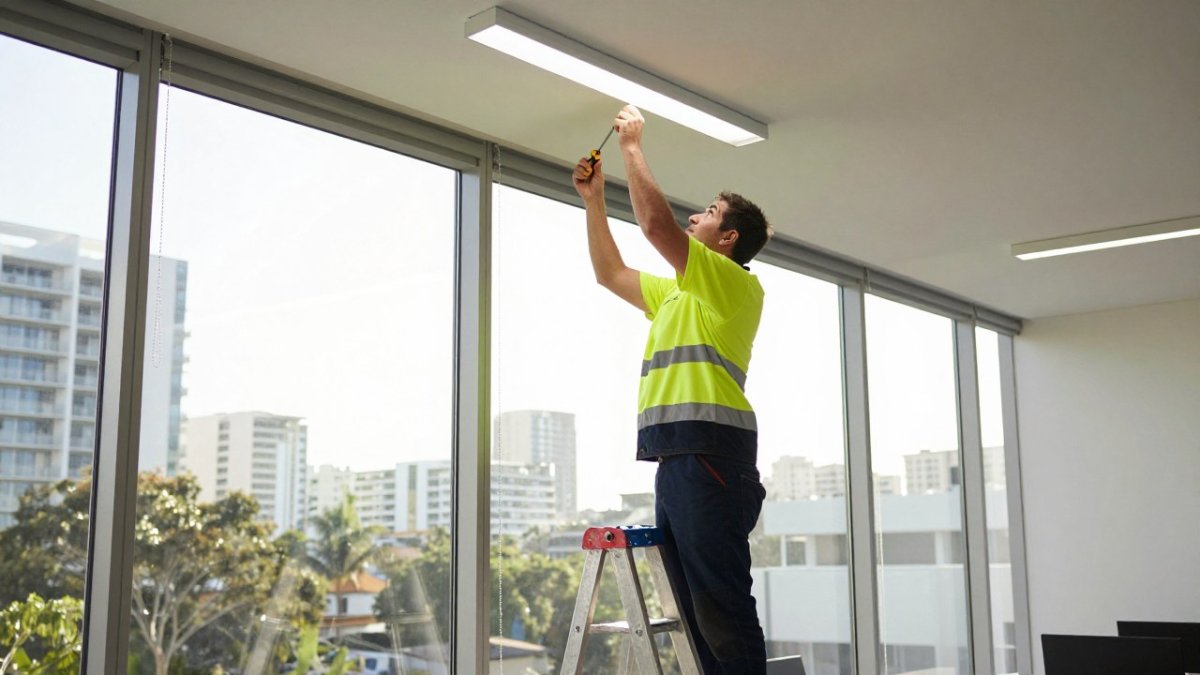
!An electrician in a branded work shirt inspects ceiling LED panels in a bright open-plan office while an office manager holds a clipboard

If you want a second pair of eyes on the job, book a lighting inspection with Brux Electrical and we will work through the checklist with you on site.
Step 2: Diagnose Flickering, Dimming and Failed Fittings
Flickering usually points to one of three causes: a failing tube or LED driver, a loose connection, or a voltage problem on the circuit. Try swapping the suspect globe or tube first. If the flicker stays, the driver or the wiring needs a closer look.
Dimming across a whole zone often means ageing fittings or dirty covers rather than a fault. Dimming in one fitting alone usually means that fitting is failing. Failed fittings that trip a breaker can point to a short, so do not keep resetting it.
Pay attention to heat. A fitting that smells hot, shows scorch marks or has melted housing needs to be switched off and replaced by a professional right away.
- Flicker in one fitting: replace the tube, globe or driver
- Flicker across a zone: check the circuit and connections
- Gradual dimming everywhere: clean and assess for replacement
- Breaker trips: stop resetting and call an electrician
Commercial LED Lighting Repairs and When to Replace Instead
Repair makes sense when the fitting is recent, the fault is isolated, and the replacement part is easy to source. Replacing a driver or a single panel can be a cost-effective fix.
Replacement is often the better choice when the fitting is old, parts are hard to find, or several fittings in the same area fail together. Piecemeal repairs on a tired system can cost more over time than a planned upgrade.
Replacing older fluorescent systems with current LED fittings can reduce power use and the number of future changes. See office wiring alternatives beyond standard layouts for layouts that can support a retrofit. Ask an electrician to compare the repair cost against a replacement quote before you decide.
A practical rule: if a fitting has needed more than one repair in the past year, plan to replace it rather than fix it again.
Commercial Lighting Upgrades That Lower Running Costs
Upgrading to efficient commercial lighting can help cut running costs, as LED fittings generally produce more light for less power and last longer between changes.
Pair the upgrade with smarter controls. Occupancy sensors switch lights off in empty meeting rooms and storerooms. Daylight-linked dimming reduces output near windows. Timers stop lights running after hours.
Consider the layout as well. Replacing older fittings in the same positions can leave dark spots or glare, so a short lighting assessment helps you match light levels to the work done in each room.
Pricing for upgrades depends on the number of fittings, access, controls and any compliance work needed. Contact Brux Electrical for a clear, itemised quote. Get a quote from Brux Electrical to see what an upgrade would look like for your premises.
Smart Lighting System Maintenance and Building a Schedule
Smart lighting adds convenience but also more parts to maintain. Sensors drift out of calibration, wireless controllers lose connection, and software or firmware updates can change how schedules behave. If the ongoing work needs more than your in-house team, an industrial electrical contractor for warehouses can carry it out.
Build the schedule around use and risk rather than a single calendar. A workable model for most Tugun offices is:
- Monthly: emergency and exit lighting checks, plus a visual sweep of customer-facing areas.
- Quarterly: full inspection of open-plan, meeting and kitchen areas, sensor and timer verification, and a review of the fault log.
- Twice yearly: storerooms, back-of-house and external lighting, plus a controls and firmware review.
- Annually: a lighting assessment that compares measured light levels and power use against the previous year, and flags fittings approaching end of life.
Prioritise by three filters: safety first (emergency lighting, exposed wiring, scorched fittings), then business impact (customer-facing areas, meeting rooms booked that week), then urgency (a single failed fitting in a storeroom can wait; a flickering fitting over a reception desk cannot). Assign one person to own the log and the schedule so nothing depends on memory.
Cost is where most quotes are vague, so ask for the factors rather than a single number. Call-out and repair pricing depends on the job, including access, fitting type, parts availability and whether testing is included. Brux Electrical does not publish fixed prices, so request a written quote through its website for current pricing.
Measure the results. Track fault counts by area, power use against the same period last year, and any complaints about glare or dimness. Over a year these numbers show whether the schedule is working and where to invest next, and they give you a defensible basis for next year's maintenance budget.
If you are ready to set up a plan for your Tugun office, speak with the Brux Electrical team about a maintenance schedule built around your building and your budget. The person who quotes the job is the one who does the work, and the team stays in touch after switch-on.
Frequently Asked Questions
How often should office lighting be maintained?
Most commercial offices benefit from a visual inspection every three to six months, with a more thorough electrical check once a year. High-use areas such as open-plan floors, reception and meeting rooms may need more frequent attention. Emergency and exit lighting should be tested on a schedule set by the relevant Australian standards and your building management records. Keeping a dated log of each inspection makes it easier to spot patterns, such as fittings that fail earlier than expected, and to plan replacements before they cause disruption.
What does commercial lighting maintenance include?
Commercial lighting maintenance typically covers inspecting fittings, checking that lights switch and dim correctly, cleaning diffusers and lenses, replacing failed lamps or LED modules, testing controls and sensors, and checking wiring and connections for heat damage. A qualified electrician will also look at lighting levels across the workspace to confirm they still meet expectations. Preventive work reduces emergency call-outs and helps keep lighting performing consistently for staff.
Should an office repair or replace faulty LED lighting?
If a single LED fitting fails and the rest of the installation is in good condition, repair or replacement of the driver or module is often the most economical choice. Replacing the whole fitting makes sense when the housing is damaged, when the fitting is obsolete or hard to source, or when the driver keeps failing. Repeated flickering across many fittings can point to an electrical or compatibility problem rather than individual faults, which is a reason to have the circuit assessed before replacing parts. Pricing depends on the number of fittings, access and parts required, so request a quote from Brux Electrical through its website.
Who can carry out commercial lighting repairs in Tugun?
Commercial lighting repairs should be carried out by a licensed electrician. Brux Electrical is a Tugun-based, owner-operated business, so the person who quotes the job is the one who performs the work, from the first assessment through to switch-on and aftercare. Before booking any contractor, ask for their licence details, confirm they are insured, and request a written, itemised quote. You can find contact details and a quote link on the Brux Electrical website.

